
CBAM-Readiness Reports
- Secretariat’s actions
-
Timeline and tasks
Tasks
As CBAM applies in the EU, on importers of goods from third countries, there are no direct tasks or obligations placed on Contracting Parties. However, because of the possibility of a time-limited exemption for electricity from CBAM, Contracting Parties may pursue completing the following tasks and milestones in order to fulfill the criteria for such an exemption.
 Article 2.7
Market coupling completed: Comprising Internal Electricity Market Regulation, including Network Codes and Guidelines especially CACM and FCA Regulations and Balancing Guideline.
 Article 2.7 (a)
Obligation to apply EU energy law: Concluded agreement with the Union with the obligation to apply Union law in energy, electricity including renewable energy, environment and competition.
 Article 2.7 (b)
Main provisions of EU electricity market legislation in place: Domestic legislation implements the main provisions of electricity market regulation and renewable energy and market coupling of electricity markets.
 Article 2.7 (c)
Roadmap completed: Roadmap submitted to the European Commission on achieving climate neutrality by 2050, aligning with EU climate acquis, including carbon pricing and an emission trading system for electricity by 2030.
 Article 2.7 (d)
2050 climate neutrality commitment: implementing climate neutrality in domestic legislation, and incorporating it in a long-term low emissions development strategy submitted to the UNFCCC where applicable.
 Article 2.7 (e)
Progress in climate aqcuis alignment: Substantial progress in aligning with the EU climate aquis including carbon pricing and the establishment of an emission trading system for electricity with a price equivalent to the EU ETS from 2030.
 Article 2.7 (f)
Import control mechanism: An effective system is in place to prevent indirect import of electricity into the Union from other third countries or territories that do not fulfil the conditions for an exemption from CBAM for electricity.
-
Legal basis and purpose
Legal basis and purpose
Although CBAM is not part of the Energy Community acquis, from 1 January 2026 electricity imports to the EU will be subject to its administrative and financial obligations, impacting generation and markets.
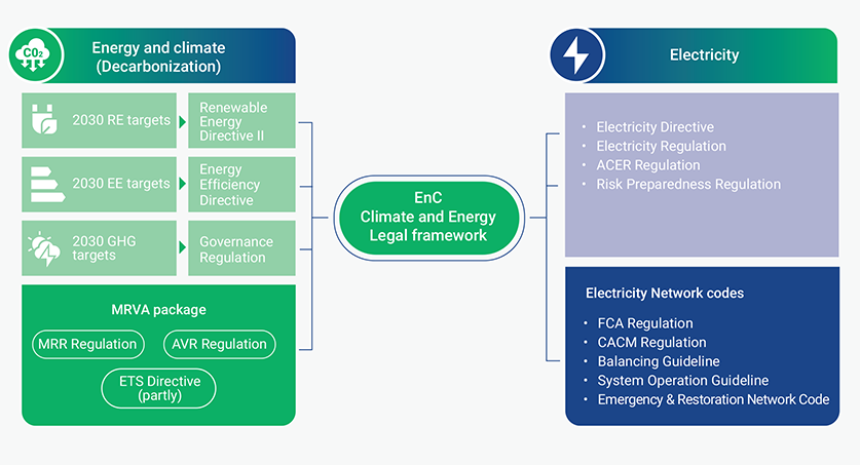
As illustrated below, the Energy Community framework already includes elements of the EU acquis communautaire in the field of electricity, including the legislation on the development of renewable energy sources, as well as rules in the field of energy, environment and competition.
KEY OUTPUT
The quarterly reports, now covering Q1 and Q2 2026, build on the previous CBAM Trackers and monitor post-implementation developments following the entry into force of the CBAM regime. They assess electricity market integration and decarbonisation in the Energy Community Contracting Parties, focusing on the WB6 and neighbouring EU Member States.
The reports analyse key indicators, including generation, prices, cross-border spreads, price correlations and electricity flows, and examine CBAM’s early effects on trade, market integration and investment. Findings remain preliminary due to the short observation period.
The Energy Community CBAM-Readiness reports progressively monitored Contracting Parties’ alignment with EU energy and climate acquis and readiness for CBAM-related requirements since 2020. The earlier Transition Trackers (from 2020) focused on broader energy market and decarbonisation progress, while the 2023–2025 Readiness Trackers provided a more targeted assessment of CBAM-related preparedness ahead of the regime’s entry into force.
Across the series, the reports tracked progress in electricity market integration (including market coupling), market developments such as trade flows, prices and generation mix, progress toward 2030 climate and energy targets (GHG reductions, renewables, and energy efficiency), and advancement of long-term decarbonisation strategies, including coal phase-out plans and carbon pricing frameworks with MRVA systems.